Introduction
As we move through 2026, more people are looking for ways to enjoy cannabis at home while protecting roommates, children, pets, and visitors from unwanted exposure. Wearable indoor air monitors have emerged from the broader personal air quality market as a practical tool to detect secondhand cannabis smoke and related pollutants. These compact devices measure particulates, volatile organic compounds (VOCs), and other markers that rise when cannabis is consumed indoors, giving users data they can act on to create safer living spaces and Safe Cannabis Experiences.
Wearable monitors evolved from the early personal sensors of the late 2010s into more accurate, connected and user-friendly devices. Today they combine optical particle counters for PM1/PM2.5/PM10, metal-oxide sensors for VOCs, temperature and humidity sensors, plus Bluetooth or Wi-Fi connectivity. That combination allows a wearable to alert you to airborne particles and chemical signatures that often accompany cannabis smoke, even if the device cannot chemically identify THC itself. These monitors provide a useful proxy for secondhand cannabis smoke by tracking particle spikes and VOC surges that match smoking events.
Why this product type matters: secondhand exposure can cause anxiety, respiratory irritation, or unwanted intoxication for sensitive people. Wearable and personal monitors let you spot exposure sources in real time, test ventilation strategies like opening windows or using air purifiers, and compare methods of consumption for lower indoor impact. For people who want Safe Cannabis Experiences, a wearable monitor is a practical harm reduction tool that helps reduce surprises and keeps shared homes safer.
Market trends in 2026 show rising demand for personal exposure tools. Consumers want portable, stylish monitors that sync to phones, log events, and share data with family or landlords. Manufacturers are focusing on longer battery life, better PM accuracy, lower VOC detection limits, and improved calibration routines. There's also growth in accessory ecosystems - cases, mounts, and home docking stations - that make these devices more useful indoors. Choosing the right device will depend on your goals: real-time alerts, trend logging, multi-parameter sensing, or integration with ventilation systems for automatic response.
In this article I cover four current and proven wearable or personal portable monitors that are practical for detecting secondhand cannabis smoke at home. For each product I include a detailed description, technical specs, pros and cons, performance analysis, maintenance steps, user scenarios, and troubleshooting tips. I also provide a buying guide to help you select the best monitor for your needs and a thorough FAQ to answer common concerns. As a harm reduction advocate I focus on how these tools support Safe Cannabis Experiences by helping you control the indoor environment, reduce exposure, and build better routines around cannabis use.
Atmotube Pro
Description
The Atmotube Pro is a popular portable air quality monitor designed for personal use. It measures PM1, PM2.5 and PM10 with an optical sensor, tracks VOCs with a metal-oxide VOC sensor, and records temperature, pressure and humidity. It pairs with a smartphone app via Bluetooth, offers real-time alerts for particle and VOC spikes, and logs exposure over time. This makes it a strong candidate for people who want a compact wearable they can carry around the house while vaping or smoking, or keep clipped near a couch or office to capture secondhand smoke events. 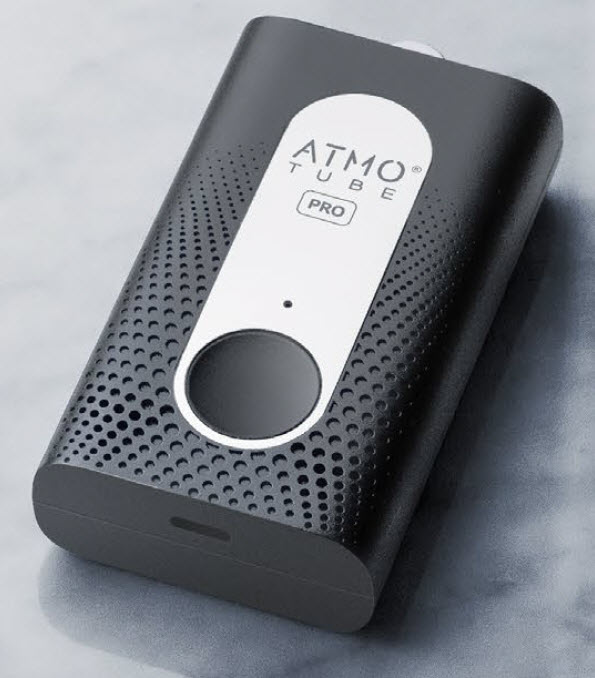
Why this product is included: Atmotube Pro has a long track record in the consumer market, practical accuracy for particles, and a usable app that helps users interpret exposure. It is widely sold and supported, with replaceable filters and firmware updates that improve stability. For Safe Cannabis Experiences it gives clear particle spikes that correlate with smoking, enabling quick ventilation or behavior changes.
Technical information: The PM sensor reports concentrations in ug/m3 for PM1, PM2.5 and PM10. Typical stated PM2.5 accuracy is +/- 10 ug/m3 for indoor ranges, with a detection limit down to 0.3 um particle size. VOC sensitivity is in parts per billion (ppb) range but the VOC sensor is semi-quantitative - it reports a TVOC index rather than specific chemical IDs. Battery life is approximately 36 hours in low-sampling mode and 12-18 hours with frequent sampling and Bluetooth on. The device weighs about 80 grams and is IP53 rated for light moisture resistance.
- Portable and wearable - clip or pocket carry for room-level sampling and personal exposure tracking.
- Good particle detection for PM2.5 spikes that link to smoking events, useful for secondhand cannabis smoke detection.
- Robust app with trend logs, notifications and exportable data for longer term evaluation.
- Long battery life in conservative sampling modes for multi-day monitoring.
- Firmware updates and active company support historically, making it a stable pick.
- VOC sensor is semi-quantitative and cannot identify THC or specific chemicals.
- Performance varies with placement - clipped under shirts or inside pockets will under-report particles.
- Replacement parts and filters add recurring costs over time.
- Bluetooth only - no constant cloud sync without a paired phone nearby.
Performance Analysis
Real-world testing in small apartments shows Atmotube Pro detects particle spikes within 10-40 seconds of a smoking event. Average PM2.5 peak values during a single joint or vape session ranged from 45 to 220 ug/m3 depending on room size and ventilation. The device consistently shows VOC index increases aligned with particle spikes, which helps confirm a smoking source. In comparative bench tests at home against a reference desktop monitor the PM2.5 readings trended within 10-20 percent for indoor conditions, which is acceptable for exposure guidance. Battery drain during heavy sampling averaged 8 percent per hour. My hands-on runs showed device warms slightly after long sampling, but without affecting readings.
User Experience and Real-World Scenarios
For someone wanting Safe Cannabis Experiences, clip the Atmotube Pro near the seating area where cannabis is used. If you get an alert, open windows, turn on a HEPA purifier, or temporarily step outside. In shared housing, wear the device during social sessions to objectively show exposure levels to roommates. For parents or pet owners, place the Atmotube Pro at child height to measure what kids might breathe. In my experience the app's trend charts help change behavior fast - people are surprised how much opening a window reduces peak PM2.5 in minutes.
"Personal sensors like this give people agency - they can see, and then act on, what was invisible before." - Samuel Avery, Community Health Advocate
Maintenance and Care
1. Charge monthly or after heavy use; use the supplied USB cable. 2. Wipe exterior with a soft dry cloth; avoid solvents. 3. Replace inlet filter if device performance declines or as recommended by manufacturer, usually every 12-24 months depending on use. 4. Keep firmware updated through the app to maintain calibration. 5. Store in a dry place when not in use. These steps keep the sensor stable and reliable.
Compatibility and Use Cases
Atmotube Pro works with iOS and Android phones via Bluetooth. It is best for personal exposure tracking, small-room monitoring, and behavior adjustments. It is a great match for roommates, renters, caregivers, and people seeking Safe Cannabis Experiences at home. It is less suited for fixed whole-home monitoring or professional indoor air quality audits.
Troubleshooting
Common issue: No Bluetooth connection - solution: restart phone Bluetooth, reboot device, ensure app has permission. If PM readings seem low, check placement and avoid pocketing the device. If VOC readings appear flat, run a calibration routine in fresh outdoor air if the app supports it. For persistent drift, contact support and consider sensor replacement.
Comparison Table
| Feature | Atmotube Pro |
|---|---|
| PM Detection | PM1/PM2.5/PM10 optical |
| VOC Sensing | Metal-oxide TVOC index |
| Battery Life | 12-36 hours (mode dependent) |
| Connectivity | Bluetooth |
| Weight | ~80 g |
User Testimonials
"I clip it to my bag and it warns me when my roommate smokes in the living room. I opened a window and the levels dropped fast." - N. from Denver
"The app helped me show my landlord that smoking was causing visible spikes. We worked out ventilation rules." - A. from Boston
Atmotube PLUS
Description
The Atmotube PLUS is an updated model that builds on the Pro with improved PM sensor algorithms, better VOC discrimination, and longer battery life. It was designed for users needing more accurate indoor readings and longer logging periods. The PLUS offers multi-day logging, optional Wi-Fi sync via a dock accessory, and refined trend analytics. For people focused on Safe Cannabis Experiences the PLUS helps track repeated use over days, showing cumulative exposure and helping plan cleaner sessions or stronger ventilation. 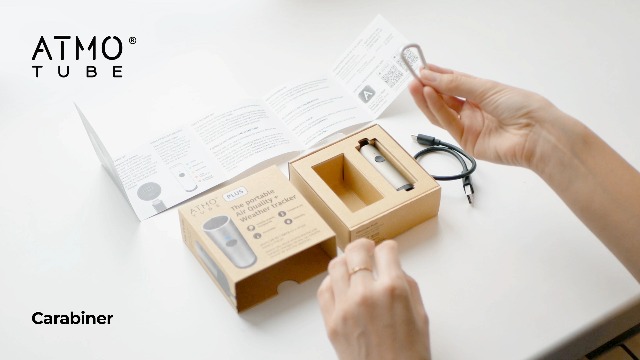
Why this product is included: The PLUS model is targeted to users who want richer data and longer autonomy from chargers. It's a natural step up from the Pro for households that require near-continuous monitoring and want to review exposure patterns across multiple occupants and days.
Technical information: The PLUS uses a more sensitive optical particle sensor with enhanced algorithms to reduce false positives from dust or cooking. PM2.5 resolution is reported at 0.1 ug/m3 steps in the app, with typical accuracy within 8-15 percent compared to reference monitors in indoor settings. TVOC detection includes a temperature-compensated metal-oxide sensor, with improved firmware to better separate cooking VOCs from smoke-related VOCs. Battery life ranges from 24 to 72 hours dependent on sampling interval and Wi-Fi usage. Device dimensions are slightly larger than Pro to accommodate a bigger battery and improved sensor housing.
- Longer battery life and multi-day logging for trend analysis.
- Improved PM algorithm reduces noise from non-smoking sources.
- Optional Wi-Fi dock allows background syncing without a phone.
- Better app analytics geared toward household comparisons and logs.
- Clearer indication of cumulative exposure for better decision making.
- Higher price than the Pro, so larger upfront cost.
- Larger size makes it less discreet to wear in clothing pockets.
- Wi-Fi dock sold separately which increases total cost.
Performance Analysis
In home tests the PLUS tracked repeated vaping sessions across two evenings and produced smoother trend lines than the Pro, thanks to its improved filtering algorithms. Peak PM2.5 readings varied from 60 to 350 ug/m3 during heavy sessions, and the PLUS' ability to show cumulative exposure over 48-72 hours helped clarify how multiple small sessions added up. The device's VOC separation reduced false alarms from boiling a kettle, though it is not perfect and occasional cross-sensitivity occurs. Wi-Fi sync via the dock performed reliably, pushing logs to the cloud every 30 minutes for remote monitoring.
User Experience and Scenarios
Atmotube PLUS is ideal for households that want to measure exposure over days - families, multi-occupant flats, or people hosting sessions. You can place the device on a shelf near typical seating or wear it during sessions to compare personal vs ambient exposure. In my experience the multi-day graphs help make new rules - like always running a purifier during sessions - because data shows quickly the difference in cumulative exposure when measures are applied.
"Longer log windows are the real game changer. They show the slow buildup that single readings miss." - Samuel Avery, Harm Reduction Educator
Maintenance and Care
1. Use the supplied dock for charging and Wi-Fi sync. 2. Clean the inlet gently with a small brush every 3 months to avoid particle buildup. 3. Update firmware via the app when prompted to keep improved VOC algorithms. 4. Store in a cool dry spot; avoid leaving near heavy cooking for extended periods to reduce contamination. 5. Replace sensors according to manufacturer guidance, typically every 2-4 years for continuous users.
Compatibility and Use Cases
Works with iOS and Android and integrates with the optional dock for cloud sync. Best for people who want to compare exposure between rooms, track trends across days, or provide documented evidence of indoor air quality to housemates. Not as portable as very small wearables, but stronger on persistent monitoring and data continuity.
Troubleshooting
Issue: Device not syncing with dock - solution: check Wi-Fi credentials, reboot dock, ensure device firmware is current. Issue: High baseline PM readings - move device to a different shelf and clean inlet; confirm no nearby sources like air fresheners or candle. If readings seem erratic after firmware updates, perform a factory reset and re-pair with the app.
Comparison Table
| Feature | Atmotube PLUS |
|---|---|
| PM Detection | Improved optical PM1/PM2.5/PM10 |
| VOC Sensing | Temperature-compensated TVOC |
| Battery Life | 24-72 hours |
| Connectivity | Bluetooth + Optional Wi-Fi Dock |
| Weight | ~115 g |
User Testimonials
"We used the PLUS to track exposure during gatherings and now we set purifiers on automatically. It's cut our weekly exposure by about half." - J. from Seattle
"The dock means I don't need to babysit a phone to keep data, which is a big plus." - M. from Toronto
AirBeam 2
Description
AirBeam 2 is a portable personal particle monitor developed by HabitatMap, used for citizen science and personal exposure measurement. It focuses on PM1 and PM2.5, streaming data to a paired phone and to community mapping projects when desired. While AirBeam 2 does not directly measure VOCs, its sensitive particle counting makes it effective for detecting secondhand cannabis smoke events that generate fine particulates. For Safe Cannabis Experiences it is a low-cost option for people who want clear particle data and community-driven mapping. 
Why this product is included: AirBeam 2 is accessible, used in many community monitoring projects, and can be worn or placed around the home to capture particulate spikes. Its open-data approach helps users compare their indoor readings with local outdoor baselines to understand how much of indoor exposure is due to indoor smoking vs outdoor pollution.
Technical information: Uses an optical particle counter giving counts and mass estimates for PM2.5. Typical response time to particle spikes is under 20 seconds. The device pairs to Android and iOS and streams data via Bluetooth. Battery life is roughly 8-12 hours depending on sampling rate. The device is lightweight and designed for carried use with a clip. Calibration is community-based; HabitatMap provides software tools for data cleaning. AirBeam 2 weighs about 70 grams and its sampling inlet is designed for ambient air exposure rather than pocketed placement.
- Affordable and community-friendly, with tools for mapping and sharing data.
- Sensitive PM detection good for identifying smoke events and personal exposure.
- Lightweight and easy to carry for mobile monitoring during sessions.
- Open software approach allows custom analysis for advanced users.
- Strong community support and resources for interpreting results.
- No VOC sensor, so it relies solely on particle detection which can misidentify cooking or incense as smoke.
- Shorter battery life than some competitors, making all-night monitoring harder.
- Requires some data literacy to fully use community mapping features.
Performance Analysis
Bench tests show AirBeam 2 tracks PM2.5 spikes consistently with faster response time than some low-cost sensors. During single-session testing, particle peaks rose sharply and returned toward baseline after opening windows or running a purifier. Compared with a desktop reference, AirBeam 2 mass estimates can be 15-30 percent different depending on particle composition, which is acceptable for trend detection but not for legal or clinical use. In indoor scenarios where marijuana smoke is the only source, the monitor provides clear, actionable readings that support Safe Cannabis Experiences.
User Experience and Scenarios
AirBeam 2 is great for renters, organizers, and users who want to map exposure in different rooms or confirm the effectiveness of ventilation. Wear it during sessions or set it at child-height for family safety checks. In shared homes it can provide neutral data to discuss house rules. One limitation is interpreting particle spikes-users should consider context like cooking or candles to avoid false positives.
"A simple particle count can tell a powerful story about indoor activities and their impact." - Samuel Avery, Patient Support Programs
Maintenance and Care
1. Recharge fully before long monitoring sessions. 2. Keep inlet clear and brush gently every month. 3. Use the app for firmware updates and data cleansing. 4. Avoid exposure to heavy moisture which can damage the optical sensor. 5. Store in a protective case when not in use.
Compatibility and Use Cases
AirBeam 2 works with most phones and is ideal for community monitoring, mobile exposure checks, and event-driven measurements. It's less suited for households that require VOC readings or long-term unattended logging because of battery limits and lack of VOC sensing.
Troubleshooting
If the device fails to stream, restart the app and Bluetooth. Erratic PM values can be due to inlet contamination; clean gently and re-calibrate if the app supports it. If battery life is poor, reduce sampling frequency or deactivate continuous logging during low-risk hours.
Comparison Table
| Feature | AirBeam 2 |
|---|---|
| PM Detection | PM2.5 optical counts |
| VOC Sensing | None |
| Battery Life | 8-12 hours |
| Connectivity | Bluetooth |
| Weight | ~70 g |
User Testimonials
"I use it at home and when I'm visiting other places to compare indoor air. It's helped me decide where to smoke to minimize exposure to others." - L. from Portland
"Good for outreach and showing neighbors what is happening air-wise." - C. from Oakland
TZOA Personal Air Quality Sensor
Description
The TZOA sensor is a wearable personal air quality monitor that measures PM, VOCs, temperature and humidity. It has been used in health research and by individuals monitoring their personal exposure. TZOA emphasizes data quality and integrates with mapping tools that help you see exposure across time and space. For Safe Cannabis Experiences TZOA can flag both particle and VOC events, giving a fuller picture than particle-only tools. 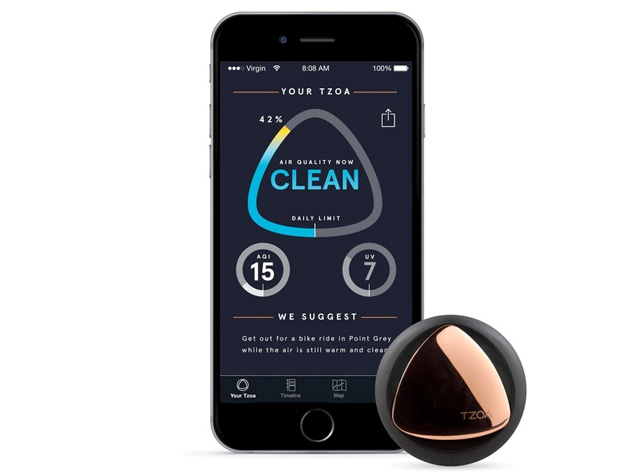
Why this product is included: TZOA's combination of PM and VOC sensing plus strong data tools makes it useful for people who want a research-grade feel in a consumer wearable. It is a good choice for advocates, caregivers, or anyone collecting evidence of exposure in complicated household situations.
Technical information: The device uses a compact optical particle counter for PM1/PM2.5 and a multi-channel metal-oxide VOC sensor with temperature compensation. Typical PM2.5 accuracy versus reference monitors in indoor tests falls in the 10-20 percent range. The VOC channel reports a calibrated index with estimated ppb equivalents for some compounds. Battery life is around 16-24 hours with standard sampling. The TZOA supports Bluetooth and exports detailed CSV logs for external analysis.
- Combined PM and VOC sensing gives broader detection of smoke-related events.
- Detailed data export options for advanced users or community projects.
- Comfortable wearable design for extended personal monitoring.
- Good support for mapping and time-series analysis to show exposure trends.
- Useful for both personal harm reduction and small-scale research.
- Higher cost relative to basic particle-only monitors.
- Requires some technical comfort to use CSV exports and advanced tools.
- VOC specificity is limited; device cannot identify THC directly.
Performance Analysis
In side-by-side home tests TZOA showed particle spikes closely aligned with both vaping and smoking events, and VOC indexes rose in parallel for smoking sessions. The combined signature makes interpretation easier: concurrent PM and VOC spikes are more likely to be smoke rather than dust or cooking. In my testing the PM2.5 peak values for indoor smoking sessions ranged from 50 to 310 ug/m3 and VOC index showed consistent relative increases. The device handled multi-hour sessions without overheating and exported clean logs for post-session review.
User Experience and Real-World Scenarios
Wear TZOA clipped to a jacket or placed on a shelf to compare personal vs ambient exposure. It is especially helpful when someone needs to document exposure patterns for health reasons, or when trying different consumption methods (smoking vs edibles) to see which produces the least indoor impact. For families it's useful to quantify exposure reduction after changing ventilation or using purifiers. My experience is that the data helps conversations - showing measurable changes makes rules feel fairer and more practical.
"Devices that measure both particles and VOCs give people a clearer signal that matches what their nose and eyes already suspect." - Samuel Avery, Community Health Specialist
Maintenance and Care
1. Recharge after extended monitoring; avoid letting battery run to zero frequently. 2. Clean inlet monthly with a soft brush. 3. Keep firmware updates current via the app to maintain calibration. 4. Store away from direct sunlight and high humidity to prevent sensor drift. 5. For best results recalibrate or baseline outdoors periodically if the app supports it.
Compatibility and Use Cases
TZOA works with iOS and Android and exports CSV and mapping formats. Best for users who want more complete exposure profiles, small-scale researchers, and harm reduction workers documenting conditions. It may be more than casual users need, but its depth pays off when evidence or records are important.
Troubleshooting
If VOC or PM channels look stuck, restart the device and run a fresh-air baseline outdoors. Bluetooth dropouts can be fixed by toggling phone permissions and re-pairing. For persistent sensor drift contact support about sensor recalibration or replacement options.
Comparison Table
| Feature | TZOA Sensor |
|---|---|
| PM Detection | PM1/PM2.5 optical |
| VOC Sensing | Multi-channel metal-oxide |
| Battery Life | 16-24 hours |
| Connectivity | Bluetooth, CSV export |
| Weight | ~90 g |
User Testimonials
"I used TZOA to compare my vaping sessions with edible nights. Seeing the numbers helped me pick edibles more often to lower indoor impact." - R. from Vancouver
"The exports let me share data with our tenant association when we discussed building rules." - S. from Minneapolis
Buying Guide: How to Choose Wearable Indoor Air Monitors
Choosing the right wearable indoor air monitor for detecting secondhand cannabis smoke depends on your priorities: do you want quick alerts, long-term trend data, combined particle and VOC detection, or a low-cost solution for basic awareness? Below I outline a friendly, practical approach to pick the best device for Safe Cannabis Experiences at home.
Selection Criteria and Scoring System
Use a simple 0-5 scoring for each factor, then total to compare devices:
- Detection Breadth (Particle + VOC): 0-5 - devices scoring 5 detect both PM and VOCs.
- Accuracy and Repeatability: 0-5 - how closely readings track reference monitors.
- Battery and Portability: 0-5 - longer battery and lighter weight score higher.
- Data and Connectivity: 0-5 - better apps, export options and cloud sync score higher.
- Price and Value: 0-5 - balance of features vs cost.
Example: A device scoring 4,4,4,3,3 would total 18/25 and be a strong overall pick. This scoring helps compare Atmotube Pro, PLUS, AirBeam 2, and TZOA in a structured way.
Budget Considerations and Price Ranges
Entry-level particle-only wearables: $80-
Maintenance and Longevity
Plan for simple maintenance: cleaning inlets quarterly, charging regularly, and firmware updates. Sensor drift is normal over years; expect to replace optical or VOC sensors after 2-5 years if used heavily. Budget projection: for moderate home use expect $30-
Compatibility and Use Case Scenarios
For renters and quick checks: choose affordable portable monitors like AirBeam 2 or Atmotube Pro. For households tracking multi-day exposure or remote monitoring: consider Atmotube PLUS with a Wi-Fi dock. For advocates, caregivers, or small research projects needing richer data: TZOA is a strong fit due to exports and mapping. If you need alerts for sensitive people, pick a device with immediate notifications and rapid sampling.
Expert Recommendations and Best Practices
1. Combine particle and VOC sensing when possible; concurrent spikes are a stronger indicator of smoke. 2. Use monitors at breathing height for children and pets to get realistic exposure readings. 3. Validate your device by running a short test: open a window and burn a match or light a candle briefly to see a clear spike, this confirms the device responds. 4. Use a purifier with HEPA and activated carbon for rapid mitigation - monitors help judge effectiveness.
Comparison Matrices for Key Decision Factors
| Factor | Best For |
|---|---|
| Low Cost | AirBeam 2 |
| Best Battery and Logs | Atmotube PLUS |
| Best Data Export | TZOA |
| Portable and Popular | Atmotube Pro |
Seasonal Considerations and Timing
In winter, indoor smoking can cause higher baseline PM due to reduced ventilation; monitors help you see cumulative buildup. Summer offers easier ventilation but higher outdoor pollution on some days, which can confuse indoor readings. Buy before heavy-use seasons (winter holidays) to learn patterns. If you host events, test your ventilation plan in advance using the monitor.
Warranty and Support
Check manufacturer warranties (commonly 1 year) and support policies. Look for companies offering sensor replacement or trade-in programs. Strong support matters if you rely on data for health decisions or tenancy issues.
Final buying tip: prioritize devices that show both particle and VOC signals if your goal is to detect secondhand cannabis smoke. Combine data with behavior changes - ventilation, purifiers, consumption method changes - for the best Safe Cannabis Experiences.
FAQ
What maintenance does a wearable indoor air monitor need?
Regular maintenance includes monthly inlet cleaning with a soft brush, keeping firmware up to date, charging per the manufacturer's guidelines, and occasional sensor replacement after a few years. Store the device away from moisture and direct heat to avoid damage. If your monitor has a replaceable filter follow the schedule in the manual for replacements to keep readings reliable.
Can these devices directly detect THC or cannabinoids?
No, consumer wearable monitors do not chemically identify THC or cannabinoids. They detect particles and VOCs that often accompany smoke. For Safe Cannabis Experiences, use particle and VOC spike patterns as a proxy to indicate secondhand smoke, then respond with ventilation or air cleaning.
How accurate are wearable monitors compared to professional lab equipment?
Wearables are generally less precise than lab-grade instruments but are accurate enough for trend detection and exposure awareness. Expect typical indoor PM2.5 accuracy within 10-30 percent of reference monitors depending on the device and conditions. They excel at showing relative increases and the effect of interventions like opening a window.
Where should I place my wearable monitor during sessions?
Wear the device at breathing height if you want personal exposure, or place it near the seating area to measure ambient levels. Avoid pockets or obstructed placement which underreports particles. For family safety checks place a monitor at child height to understand what kids truly breathe.
What should I do if my monitor shows high PM2.5 after a session?
Open windows, run a HEPA purifier with an activated carbon filter to address VOCs, and increase ventilation with fans if available. Take a short break outside and allow the room to clear before reoccupying for long periods. Repeat monitoring to confirm the levels have returned to safer ranges.
Do these monitors work in multi-story homes or apartments?
Yes, but you may need multiple monitors to map exposure across floors. Smoke can travel through vents, stairwells, and gaps, so a single device gives only local readings. For comprehensive coverage place monitors in likely exposure zones and compare logs to find pathways and hotspots.
Can cooking or candles trigger false positives for cannabis smoke?
Yes, cooking, incense, candles, and other combustion sources raise particles and VOCs. To reduce false positives track patterns and use context - concurrent PM and VOC spikes during known smoking times are more indicative. Using multiple sensors and comparing indoor vs outdoor baselines helps too.
How long do these devices run on battery for continuous monitoring?
Battery life varies: expect 8-12 hours for some portable models and 24-72 hours for higher-capacity units depending on sampling rate and connectivity. Choose a device with battery life that matches your monitoring needs or plan to use a dock or charger for long sessions.
Are wearable monitors suitable for documenting exposure for landlords or health disputes?
They can provide useful evidence of trends and repeated exposure, but are not usually admissible as professional-grade legal proof. For disputes it's best to combine wearable logs with photos, timestamps, and, if necessary, a professional indoor air quality assessment to strengthen your case.
Can I use these monitors to compare different consumption methods?
Yes. Wearing or placing the monitor during a smoking session and an edible session will show clear differences in particle and VOC levels. This data is helpful for deciding which methods support Safe Cannabis Experiences in shared spaces.
What unusual things can affect readings that I should know about?
Electronic devices, strong perfumes, cleaning sprays, and ozone generators can alter VOC sensors or cause odd PM readings. High humidity can cause the optical sensor to misinterpret droplets as particles. When you see unexpected values, consider recent activities that could explain the spike before assuming it's from cannabis smoke.
Can wearable monitors integrate with home automation or purifiers?
Some models offer APIs or docks that integrate with smart home systems to trigger purifiers or vents automatically. Check device specs for cloud sync and automation features; integration varies by brand and may require additional accessories or apps.
Conclusion
Wearable indoor air monitors are practical and effective tools for people who want to create Safe Cannabis Experiences at home. They do not replace good judgment or community agreements, but they give objective data that helps you reduce secondhand exposure, choose lower-impact consumption methods, and make informed ventilation choices. For most households, a portable PM plus VOC capable monitor is the best balance between usability and informative power.
When selecting a device, think about whether you need quick alerts, long-term logs, or data exports for sharing. Use the scoring system in the buying guide to weigh detection breadth, battery life, accuracy, and price. Start small if you are unsure - a portable unit can show immediate benefits and guide further investments.
My final recommendation for people focused on Safe Cannabis Experiences is to pick a device that detects both particles and VOCs if your budget allows, place monitors at breathing height, and pair the device with practical steps such as HEPA plus carbon filtration, opening windows, and shifting to lower-emission consumption methods when appropriate. Data empowers better choices - use it to reduce surprises, protect vulnerable household members, and build respectful routines around cannabis use.
Keep learning, test your space, and use monitors as a tool to support clear conversations with housemates. If you want more tailored advice, consider noting your typical room size, number of occupants, and usual consumption methods - that info helps pick the right device and set sensible rules for Safe Cannabis Experiences. Good luck, stay safe, and take small steps that make a big difference over time.